SCOTUS ruling + new 10% global tariffs
The Supreme Court ruled 6-3 that President Trump overstepped his authority by using IEEPA (International Emergency Economic Powers Act) for sweeping tariffs – that applies to 1) fentanyl tariffs on China, Mexico & Canada, 2) “Liberation Day” / baseline reciprocal tariffs, 3) 25% secondary tariffs on India) - generating ~$200 billion. Roberts wrote that IEEPA covers sanctions and asset freezes, not taxes on goods—a power reserved for Congress under the Constitution. Markets' initial reaction to SCOTUS’ ruling was by shifting inflation expectations lower, slightly risk-on and pricing in an uglier version of a fiscal backdrop; US$ fell, Gold dropped $60 (but recovered) and equities/risk rallied.
Trump then immediately imposed a new 10% global tariff under Section 122 of the Trade Act (sector-specific tariffs, 232 and 301 tariffs remain in place), while Democrats push for refunds and some Republicans praise the check on executive power. Overall markets treated the new 10% global tariffs as a nonevent (SPX/risk up modestly, Gold recovered all loses and more); its aint Liberation Day 2.0. Markets knew there were other tools (section 122, 301 and ongoing 232 investigations). The constraint and new change here is time & speed, not authority; Trump may have lost a tariff battle but not the tariff war. Plus, companies have already rejigged supply chains in response to Liberation Day (many global tech firms began diversifying risk away from China in 2017/18 trade war era!); the Supreme Court ruling is not going to undo supply chain reordering.
The Supreme court did not rule against President Trump's tariffs; just that IEEPA cannot be used to raise revenue. Bessent said "We will be leveraging Section 232 and Section 301 tariff authorities that have been validated through thousands of legal challenges” – expect meaningful tariff escalation from the White House (ie: s232 tariffs could be increased) and the return of tariff uncertainty (more policy curveballs) sooner rather than later.
On refunds: the headline number is large but the realistic payout for importers (who have already passed the cost onto consumers) is not. Trump admitted refunds will be bogged down in lower courts; Bessent said in January, the money is there but repayments would be spread out “over weeks, months, may take over a year” and it’s a “corporate boondoggle”. The world is still short lawyers. And there is a chance (not zero probability -- expect the unexpected) that “tariff refunds” is a way to get checks to taxpayers ahead of midterms in response to the SCOTUS ruling.
Section 122 allows temporary tariffs (up to 15%...so 10% is the minimum) for up to 150 days to address balance-of-payments issues, without needing immediate Congressional approval. What happens after is TBD. It is a rarely used tool (never fully invoked in modern times), so details like product-specific exemptions would likely come via implementing regulations, executive orders, or US Customs guidance in the coming days or weeks. We are back in the murky 1H'25 phase. It's likely the administration INTENDS for Gold and other precious metals to be exempted, but this is not stated now.
SCOTUS decision is a win for reinforcing rule-of-law frameworks limiting executive overreach. But "tariff uncertainty" returns and the US' fiscal trajectory gets messier and uglier (the negative fiscal impact of OBBB now is no longer offset by “meaningful tariff revenue” from IEEEPA); that is positive Gold in the medium-longer-term.
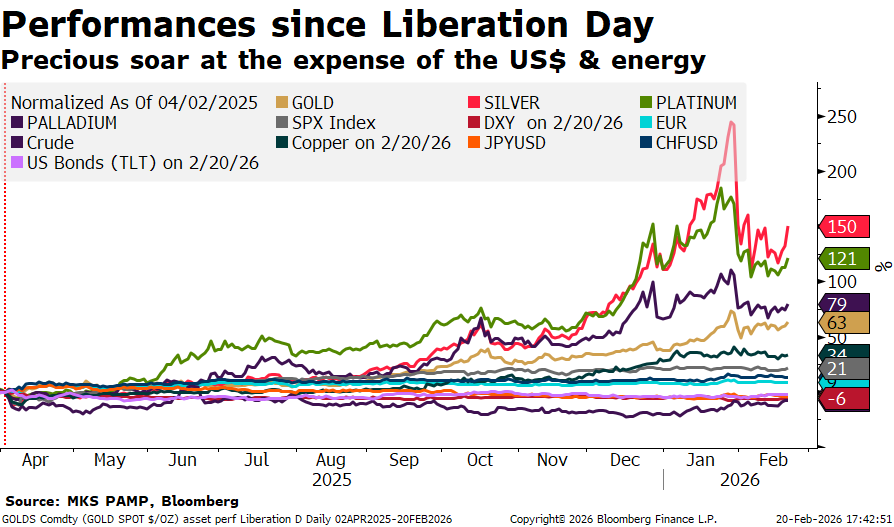
Graph shows performances since Liberation Day (April 2025) FWIW.